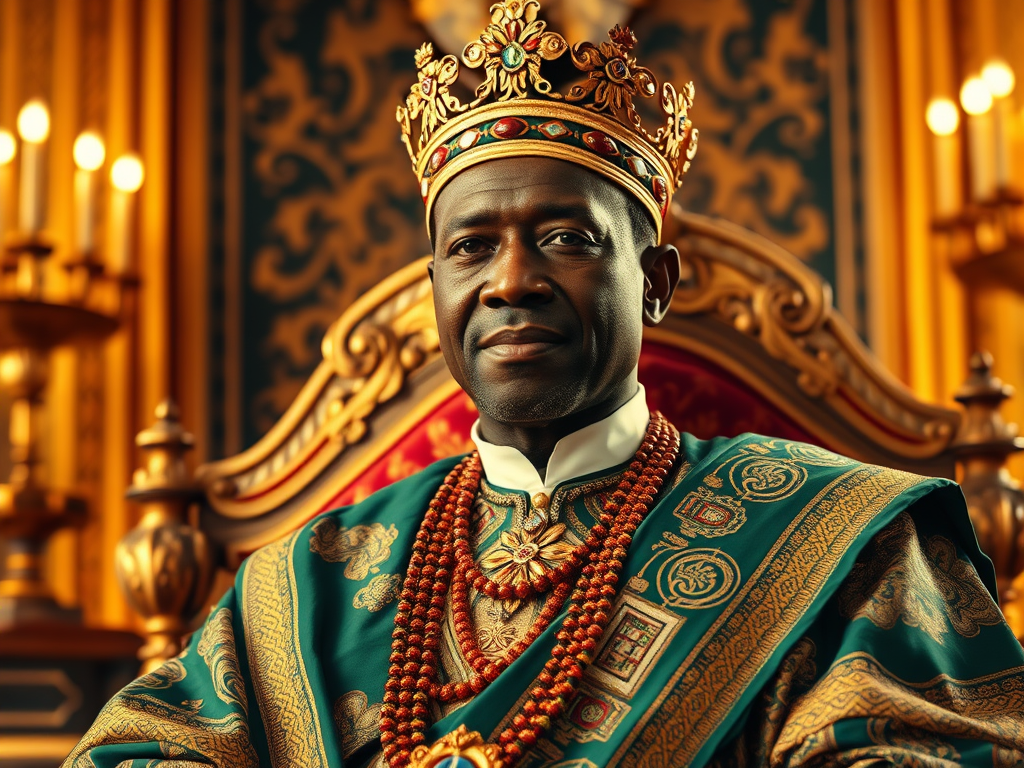
African countries may need to bring back monarchies as the heads of state. Before I delve further into this essay. Monarchies are not antithetical to the democracy. However, the democratic process that is prevalent within the political circumstance of a constitutional republic has proven – for much of postcolonial African society – to be underwhelming. The model I will further describe is alive and well in largest empire to date – The British Empire under the jurisdiction of King Charles III.
What kind of Monarchy? First, let us address the type of monarchy. The monarch in question would sit outside of the civil republic structure but will have responsibilities that are crucial to the well being of the nation. They may not need to replace the republic but would be on top of it and have authority over it. Lot of empires that were broken up to create the current countries in Africa since the Berlin Conference of 1884 were run by monarchs; kings and emperors; chiefs and Fons. The monarch was the most powerful person by authority and wealth and contrary to popular belief they had institutions and councils underneath them that operated democratically. We may not be able to relive the past but it is clear the baby may have been thrown out with the bath water. In history, the one area a monarch was vulnerable was in his responsibility as the steward of the wealth of his jurisdiction. Although he was upheld by absolute authority to tax his populace he was responsible for trade deals that would enrich or oblige his people. There was a direct link to his judgment in these matters and the well being of his people that if he made bad trade decisions the people would suffer and if he made great decisions, they would thrive. There was also the tacit understanding that misallocation of the nation/kingdom’s wealth could mean assassination by someone from his court. This was universal that even tyranny seldom protected demagogues from such fate. They may get away with miscarriage of certain civic rulings but when resources ran dry, upheaval was sure to ensue. Look to the eras of the Dark and Middle Ages in Europe when ironically, African empires had their regencies stabilized.
The Rise of the Dictators: If you have been following post colonial African history the above description almost sounds like petri dish for power abuse galore. This is where our education of Africa has been heavily mischaracterized to the extent that the African (& diaspora descendants) in today’s world feels they are not allowed to address their understanding of political power for fear of being considered backward. Meanwhile, this model is fully operational in the Persian Gulf states and more than half of Western Europe. The model of the constitutional republic as a solution to all of a people’s needs sometimes misses the mark. In fact, the constitutional republic paves the way for the democratically elected DICTATOR. Most dictators in Africa and beyond often rose to power via an election or via an uprising on the backs of the effort of the people. The model of the republic then secures them as they willfully ignore or rewrite the terms of the constitution using the power of the republic to further disempower the people in favor of themselves. In a republic where the people believe the constitution is the answer, they will do everything to use the constitution to remove this dictator at first, which most often than not, fails. Only when such dictators are toppled in a coup d’etat do they get some reprieve. At which point, another dictator rises and eventually comes up with a similar scheme. In a monarchy, the king cannot hide behind a constitution to gain or dismiss the people’s trust. He/She is granted that at the outset, thus they are obliged to solve the dismay suppress dissent. History shows the monarch is much better off addressing the discontent of the people instead of suppressing dissent. In the long run, unhappy people make for vicious rebels and without a republic the palace is ground zero. A republic shoots for bipolar or multipolar power distribution which is great for freedom of expression and healthy debate but when it comes matters of effective organization and matters of public welfare there tends to be extenuating red tape and gridlock because the virtue of the republic is power distribution over effective operation. This multipolar arrangement is great for dissemination of responsibility and the obfuscation of dissent.
How does Monarchy Fit? Is the republic better than the monarchy or is the monarchy better than the republic? Well, the answer is almost ironic. A monarchy cannot thrive under a republic but a republic will thrive under a monarchy (as seen in the United Kingdom, Spain, Belgium, Netherlands, Denmark). The African politicians who are devoted to serving as civil servants in a republic such as court judges, parliamentarians, senators, cabinet ministers need not fret. Their roles are very important for the management of the nation’s politics. However in areas of wellbeing of the people, in areas such as literacy standards, civic & social morale, care of vulnerable (old & young) & defense spending, monarchies have a much better track record. Interestingly, most monarchies seem to have socialist policy around the public welfare which in the U.S are often attributed to high civil taxes. But if you were to look at the cost of these sectors in nations such as the UK, Sweden, Denmark, Belgium & Gulf States, you would realize high taxes are not the primary means for securing welfare funding. These nations greatly benefit from trade negotiations at the Palace level that are allowed to flow into the public coffers via the Monarch. However, seldom is it brought up that these are monarchical societies where the crowns are quite sensitive to the displeasure of the people because of past occurrences of decapitation on palace grounds of one or more of their ancestors.
But Africa had this! Most of African societies are communal in terms of social inclination and are very amenable to someone with authority being responsible for their wellbeing while the person in authority is sensitive to the wellbeing of his/her subjects. Unfortunately, this changes with the establishment of the post colonial republics where people arose from families that had not been brought up in duties of a monarch to understand the traditional expectation of authority in their respective African cultures. A newly educated class emerged with new under-verified ideals (with regards to how they applied locally) and deviated way too hard on the tradition. Like clockwork, despite the constitutional novelty, the cultural impulse was the same. The person at the top wanted to act like a monarch but within a republic he was not allotted the authority, duration or leverage. Thus most first presidents spent decades trying to secure authority, duration and leverage at the expense of the constitution. This now results in the appearance of dysfunction. We also see in the format of the republic, that the president is unable to fully be an arbiter in trade which for mineral rich countries in Africa would be the proverbial crown jewel. The civil servants and cabinet ministers or even provincial and federal governors would all need to be recruited into a trade ethos and depending on the person at the head of the republic, this ethos could change as part of the multipolar model. The diversity of opinion and operational gridlock would ensnare African territories as trade partners. It should not be any surprise that officials down the line become more and more susceptible to the attractive offers from foreign partners now that the monarchy is not the sole arbiter of the region’s trade ethos. This alone has created the slide into such corruption that unfortunately, several African nations have opted to view this as fundamental reality as opposed to flawed design.
The Reversal: Now, the most bitter pill to swallow in all this is that in order for this to work, the monarch must be the wealthiest in the nation by leaps and bounds. The monarch has to be almost 3x if not more, richer than the nations operation budget. One of the reasons for that is so that in the event of a famine of a catastrophe, they would be able to step in to ease their people’s woes. A monarch who oversees their nation’s wealth while having much in store is closer to being a generous one that a president who is the first in his bloodline to attain wealth and has made it his life’s mission to attain wealth often still below that of the nation’s richest oligarch. Few dictators have been shown to possess the discipline of wealthy born monarch.
Finally, this is not an easy notion to digest. It challenges the contemporary mind that has been educated to perceive the constitutional republic as the summit of democratic practice. It may sound ridiculous to anyone living in or who has lived in a post colonial state where the president and his cohorts promised democracy while trying to practice monarchical authority. The difficulty lies mainly the lack of thoroughness of post colonial political scholarship. Was this thoroughness obstructed, disincentivized or avoided? I am not sure.
by Julian Michael Yong
 X U L A I M A
Leave a comment