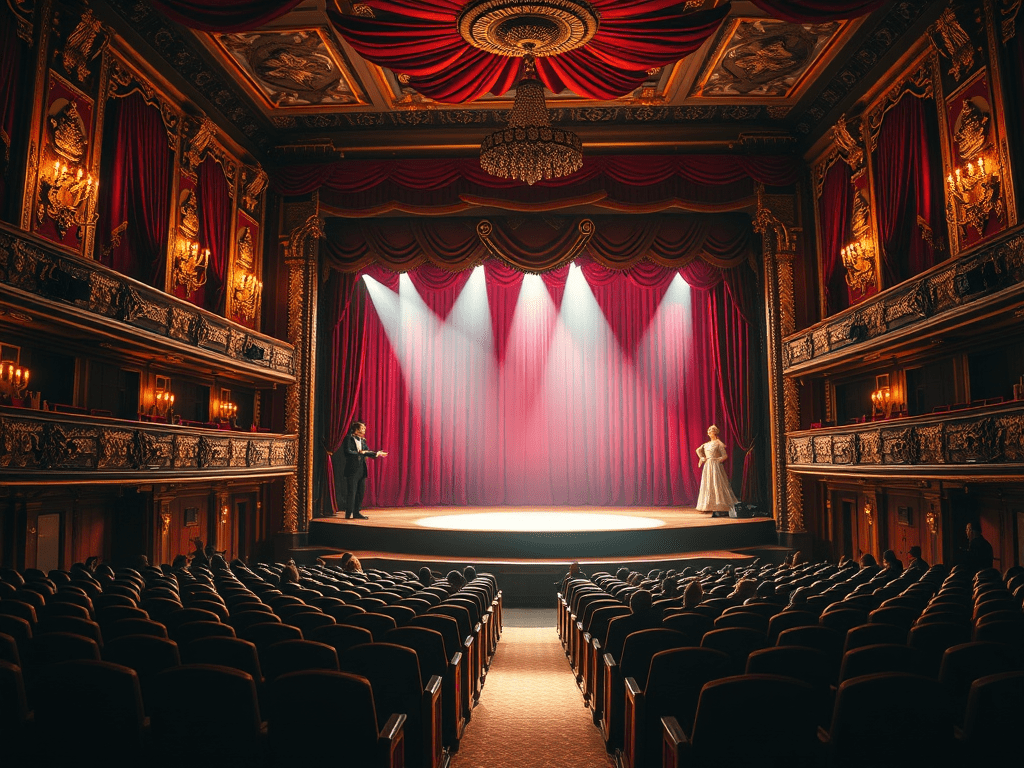
Oscar-nominated actor Timothee Chalamet recently faced controversy for casually expressing that no one attends Opera or ballet. I would like to add to that, theatre. Truth is, there has been a drop in theatre attendance for over a decade. Unfortunately, the recent pandemic lockdown from 2020 – 2021 precipitated this decline even further. However, the larger reason for this decline is beyond the protection from infection. Theatre, opera, ballet and live entertainment that is often borne of years of institutional training has grown into a niche activity in the United States. Consequently, this applies to the movie and TV industries as well.
Theatre and Opera were once high brow fare in the United States during the early industrial era (18th – 19th centuries). It was a venue for the rich aristocrats to come make fun of themselves whilst the commoners to come catch a glance and from the pit and laugh, in catharsis, at a lifestyle they would seldom attain. Ironically, actors were often plucked from people who were among the more amoral striver class. They were better at going from role to role whilst indulging in mannerisms and perspectives, the average person might avoid. Most people prefer to remain in harmony with their immediate social environment aka community. However, in the early 20th century, theatre was turning into an echo of a huge part of American culture. By the 1930s. Playwright, Clifford Odets notably helped launch a labor union with his play WAITING FOR LEFTY. He went on to write and produce other plays such as; PARADISE LOST and GOLDEN BOY before he was deemed a political threat by the House of Un-American Activities steered by Senator McCarthy in the 1950s. This was a political agenda set on course to root out any ideas that seemed to favor the proliferation of communism in the United States.
The class consciousness from the 1930s and 1940s was chased out by the 1950s. Cinema was close behind with such filmmakers as Frank Capra, Sidney Lumet and John Cassavetes. Art as a voice and echo of the oppressed masses a la Frantz Fanon was deemed a threat to the power structure. What happened after is probably the greatest industrial psyops in the United States. Technically, it was returning to form but still… Art became expensive as an activity, as a hobby, as a product as a lifestyle. Bohemian went from a mark of squalor to a fashion trope. Maintaining a theatre troupe became a fundraising nightmare as maintaining a theatre building came with high rents and high cost of operation. These can be viewed as par for the course with the growth of an economy but the biggest violation of all was when playwrights went from discussing class issues to emotional and psychological issues. More Tennessee Williams less George Bernard Shaw, Clifford Odets or Bertolt Brecht. Drama training went from being a blue collar apprenticeship to a cultural religion.
It is as though, the dramatic world was made to understand certain truths were off limits because of the potential for change they carried. However, the cost of putting on shows was made very expensive as could be seen in their industrial corollary, Hollywood that was putting up ostentatious costs to recreate the sentiment theatre had been carrying on for ages. Thus, if you wanted to tell the truth about class in America it was going cost you.
By the 1970s, succeeding in making a movie or running a theatre company came largely through very wealthy benefactors who were investing in the proliferation of their role in society. In movies, it came from industrialists in Energy and Technology and on television it came through advertising revenue. The message was loud and clear, narrative is sponsored and not reasoned. The closer to the truth you get, the more it will cost you (either before the show or after its release). By the 1990s, getting into the arts was largely for the rich kids but advertised as “useful to everyone”. But getting into an arts conservatory, you would see that you were being inculcated into tastes, mannerisms and perspectives largely catered to a ruling class that does not care to alter struggle but rather seeks to have their point of view reinforced even among the poor. What does this look like?
Most working class people would be anchored in perspectives they can afford. A typical working class person would value having a stable income, stable relationship, a regular place of worship and a family system they can rely on. Rich people take this for granted. They may not live on an income but they generate revenue in multiple ways so they may not share the inhibitions of someone who has to get up in the morning to show up at a job they do not love. They may not view relationships/marriage as an anchor or may not value being a stable partner as they can afford certain indulgences or are allowed these indulgences. For a lot of them, religion is not necessary and for those that believe in God, their fortune prevents them from having a fear that most of the working class depend on to manage their nervous system. Their families are often dysfunctional and end up being riddled with sexual abuse, incest, emotional dysregulation and mental illness.
Notice how the term “would” is used for the working class in the previous paragraph. If you are paying attention to America today, a lot of what I described as typical to the rich is widely on display among the working class today. In fact, never before in American society has the working class taken on the qualities of the upper class – largely to their detriment. Today, the dysfunction among the working class is alarming. We have a high divorce rate, religious institutions that once anchored communities are closing, what used to be family scandal is now single-parenting. What used to be mental illness is now a legally protected demographic classification. Now, I do not bring these up for moral framing but I would like to point out the overall cost of existence on the working class today because all this ideological accommodation. More working class kids take on loans to attend private institutions (valid but still financial risk). Broken families lead to parents paying double rents and double amenities to raise a kid or kids in two separate homes. Trying to manage the incongruities of life without a faith practice while low on funds is an existential crisis that often leads to a spiral.
The arts in the United States, in its need to appease the fragility of the aristocratic power structure has put upon the masses a model of existence that is unsustainable to the average working class person. However, we are being sold to as the target audience for what is highly incongruent with our daily lives or what is worth consideration to add to our daily sensibilities. We are now in the early 21st century and we are engulfed in the creativity of 2nd generation nepo-babies and elite educated working class artists trying to tell the rest of us that our tastes need revision. So the parents who have broken relationships with their children, the spouses who have lost their partners, the kids whose parents have subjected them to social experiments have all lived the catastrophe that is “The Arts”. People are tuning out. In 2020, when people saw Hollywood become the apostles of the power structure most people who were struggling against the tide began to turn. Zoom calls that revealed manicured lawns and glass walls far behind a lengthy couch really got people in their feelings as they saw their jobs and livelihoods disappear. This was not a fault of the art forms. This was largely in protest of the artists. When the artists chose to echo the powerful over the cries of the struggling, a veil was lifted.
Art is amoral. Much like a mirror, it reflects the object(s) in view. If you put on a red shirt before you leave home and when you looked in the mirror, it showed a purple shirt, it makes sense to think you have a purple shirt on. However, if someone brought you an untampered mirror and it was revealed to you that you are in fact wearing a red shirt, the wise thing to do would be to acknowledge that you are wearing a red shirt. But if you want to have fun, you can have all the untampered mirrors destroyed so that the only ones available are the ones that show you have a purple shirt. Think of how many more distortions will be proliferated all because you did not want people to say you are wearing a red shirt, which they can see with their naked eye. You cannot be surprised when the people then decide to stop buying mirrors altogether. You cannot be surprised when making mirrors is no longer profitable.
The high cost of art is beyond the financial expense. It has huge social and psychological toll on the masses. They may find a lot of what is sold to them as unrelatable while realizing that trying to live within what is shown is unfeasible. Anti-social behavior masked as quirkiness is expensive. Sexual promiscuity masked as sexual freedom is traumatizing. Dismissing spiritual anchoring or joking about faith is demoralizing. When people are already struggling to cope with basic living costs, they are very vulnerable. If you give them hope, they seek solutions. If you give them false hope you create cynics. But if you sell despair as liberation, you are creating a mass of walking dead.
It should be noted that the Opera still offers highly relatable themes in their storylines with such famous pieces as FAUST, LA BOHEME, CAUCASIAN CHALK CIRCLE. Ballet still offers us classics such as ROMEO & JULIET, BLACK SWAN etc. However, opera and ballet as activities have long gone from the average palate due to the initial cost of participation for many. The last time I looked at tickets to the opera in my city, the lowest price was $85. That’s an expensive date for someone who does not expect 50/50. The issue with opera, ballet, theatre and eventually film and tv, is how they have been sold as cultural tastemakers. The skill/craft in each of these is worth being taught to many as they teach a whole lot about aspects of physical control to spiritual awareness – integrated existence, if you will. But if you are primed to view these skills or techniques as exclusive tools to be amenable to a class of people who indulge in lifestyles that do not intrinsically serve the greater good, how can we be surprised when less and less people of the masses care how they fare.
by Julian Michael Yong
 X U L A I M A
Leave a comment