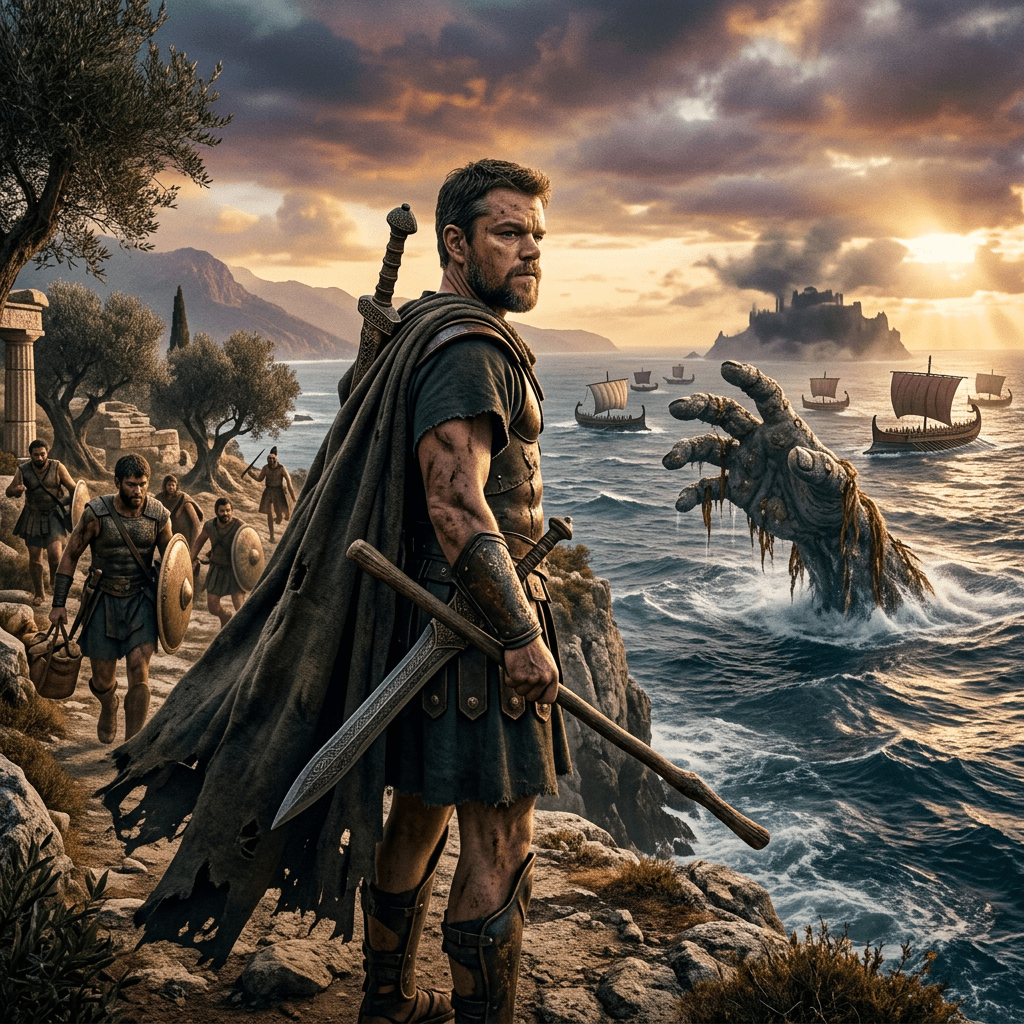
Christopher Nolan’s Odyssey is the subject of lot conversation on X (formerly Twitter) and YouTube. The official media sites are sounding their praises while independent movie reviewers on YouTube are sounding the alarm. Who is right? Who is wrong?
This question is one which may not even be answered by the box office. Good movies sometimes flop and bad movies sometimes open well. However, there might be another way to look at this phenomenon. In drama school, we had to study the Robert Fagles translation of the Odyssey. I still have my copy and I decided to open it to see if I had the patience to read it again. I got tired of opening YouTube and seeing either the movie and culture critics frustrated by the casting or the out of touch academics who did everything they could to say whether or not they cared for the casting.
Upon opening this tome, I discovered a 60+ page introduction. What the hell. That was a long introduction. However, 5 – 10 pages in, it dawned on me. The Odyssey is no stranger to disagreements about its interpretations since HOMER, the presumable author. He apparently put in writing (verse) an oral poem from the Mycenean civilization. He faced disputes over the phrasing and the verse of the poems. Scholars after him argued over this for centures and even millennia. The Mycenean era was old history to Homer. Homer was history to the Athenian era with Socrates, Plato and Aristotle. The Athenian era is ancient history to us in 2026 C.E.
The Odyssey, it turns out is also the foundational tale to Western storytelling. It bears the themes, tropes and types of conflicts between man, woman, gods and nature that all compelling narratives are wont to have in order to engage audiences. Along with The Iliad, The Odyssey, does not necessarily honor the three-act structure but the events within them can be retold through adaptation by another author, director, painter or sculptor according their taste.
It should be no surprise when see stories such as Miguel de Cervantes’ DON QUIXOTE or Voltaire’s CANDIDE, to even the true story of one LAWRENCE OF ARABIA by David Lean and the fictional tale BIG FISH directed by Tim Burton. How can we even forget Stanley Kubrick’s 2001: A SPACE ODYSSEY?
I throw these stories at you to set up a dichotomy you may not have seen coming. But let me try to do so without diminishing modern creativity or worshipping ancient fables. As a moviegoer in 2026 we are just coming out of two cultural phenomena that we may not quite be fully aware. They both occurred in sequence to great market impact for one set and great sociopolitical impact in another. We just experienced 18 years of fantastic comic book adaptations that turned into blockbusters and these blockbusters turned into sociopolitical engines for social cohesion and geopolitical framing. The last twenty years, saw us redefine our cinematic reality according the imaginations of Stan Lee (of Marvel) and Bob Crane (DC). From Spider-man starring Tobey Maguire in 2002 to the Avengers Endgame in 2019, we went from movies being the products of the collaboration between Hollywood Studio players and film directors with imagination and renegade spirit enough to convince a media machine that they could millions of people to look at a giant screen in the dark without the having to entertain characters with superpowers. There was sci-fi as a genre but it was not the norm. Comic book adaptations were even more niche. Think Tim Burton’s Batman starring Michael Keaton or Blade starring Wesley Snipes.
The introduction of the comic adaptations brought a tacit understanding. The comics were a depiction of a sociopolitical morality from the imaginations of writers and creators from the 1950s and 1960s that were meant to score relevance with their readers. The characters such Prof X and Magneto in X-Men were attempts to portray the civil rights leaders in Martin Luther King Jr. and Malcolm X and the world of Wakanda was meant to speak to the growing Pan-African sentiment that was criticizing the exploitation of African minerals. The comics were not written to impress only black people. I am using those examples because they are the easiest for me at the moment. I do not have the experience of being a billionaire like Bruce Wayne or Tony Stark or psych ward experience like “The Joker”. So don’t come for me. However, given how recent the context of these worlds are compared to The Odyssey or The Iliad, there is an expectation of fidelity to the source material that is incomparable.
The Odyssey is so old it precedes our context of race, democracy and the three popular religions of Judaism, Christianity and Islam. It precedes a lot of the contructs that the writers of the comics made their bones on criticizing. Not only that, but the variety of criticism over The Odyssey over the centuries has largely been about the literary interpretations such that more dissertations, papers and cultural assertions have been made over the phrasing, grammar and poetic structure of the Odyssey rather than the visual reality. So when we have a generation of moviegoers who are used to assessing the quality of their movies from the ability of filmmakers to be faithful to the source material that was created less than a century ago in visual media, it should not be surprising that when thinking of an age old tale like the Odyssey, their first reaction to visual inconsistency is in fact – SACRILEGE!
Now to be fair, such criticism is not wrong. Deliberate deviation from visual consistency is worth questioning. But the task of criticizing the Odyssey in academic, literary and historical culture has been largely more about the thematic, linguistic and symbolic rather than visual. Visual representation often embodies more than can be argued for or against but when it comes age-old work of the Odyssey visual critiques are only putting up rookie numbers.
But please do not hold back on your views on where you think it departs from the original. Just be willing to understand, due to how far the original is from most of the people who have ever interacted with it, including its alleged author, most have settled for adaptations in service of their era to which Christopher Nolan seems to be aptly doing. He is choosing to do what artists before him have done. Rather than seek the true Odyssey tale, he is choosing to tell the Odyssey as people of our time and social mores may be willing to understand it even if it means subduing or alternating some of the characters to do so. The idea behind this just may be: the Odyssey is just the story of us. A dream once revealed to a poet of old that can be redreamed by the modern poet like him. Let’s not forget Christopher Nolan holds a bachelor’s degree in English Literature. He’s no stranger to world of language over image.
by Julian Michael Yong


Leave a Reply